Computer program for
graphical representation
of family constellations
What is a genogram?
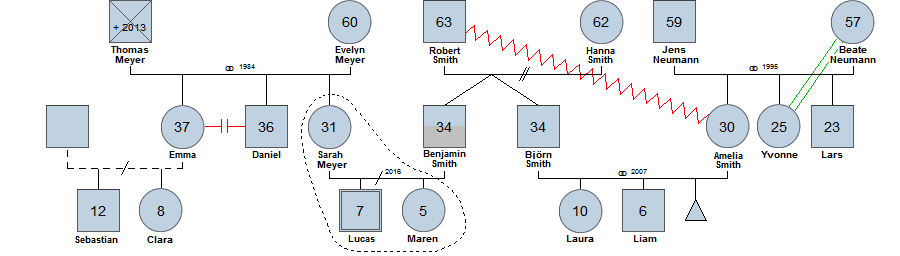
Difference between family tree and genogram
A family tree documents purely biological lines of descent - who is related to whom and in which generation. A genogram goes significantly further: it supplements this structure with information regarding relationship quality, conflicts, illnesses, professions, critical life events (e.g., separations, deaths, relocations), and emotional connections between family members. Thus, while a family tree depicts a purely structural layout, a genogram additionally provides a psychosocial map of the family.Person symbols
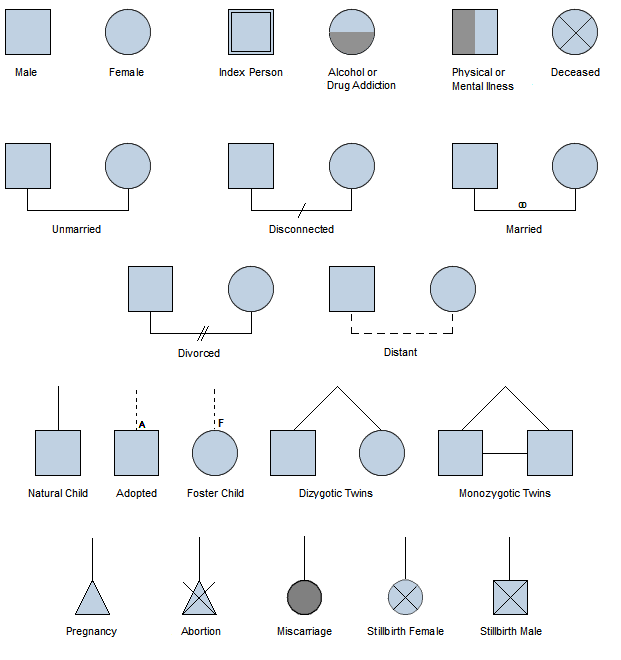
Genograms follow standardized graphic conventions:
- Square = male person
- Circle = female person
- Crossed-out symbol = deceased person
- Double border = index person (the person who is the primary focus)
Additional information such as age, years of birth and death, or occupation
is noted inside or directly next to the symbol.
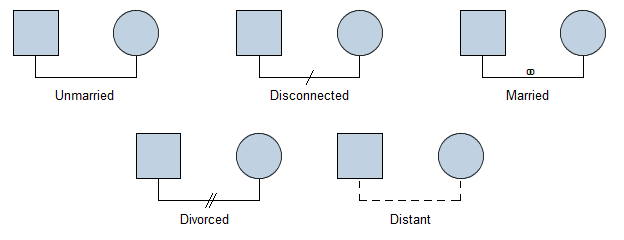
Types of relationships / Forms of partnership
Connecting lines between the symbols indicate different types of relationships:
- Solid line = Marriage/partnership
- Dashed line = Non-marital relationship
- Line with a slash = Separation
- Double slash = Divorce
- Lines extending downwards = Parent-child relationship or lineage
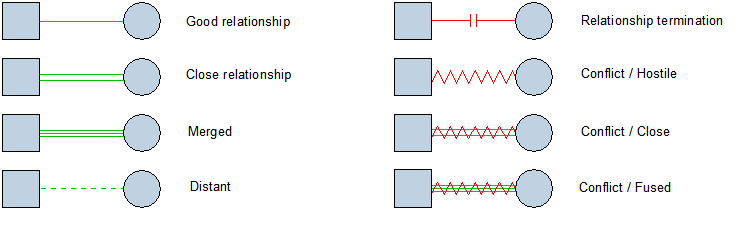
Emotional relationships
The emotional qualities of relationships between individuals can be represented
by specific line types:
- Close/harmonious relationship: parallel solid lines
- Conflict-ridden relationship: jagged line
- Distant or severed relationship: broken line
- Enmeshed, very close relationship: multiple parallel lines
This symbolism makes visible family dynamics that would remain hidden
in a purely genealogical family tree..
Genogram in Psychotherapy
In psychotherapy, the genogram serves to identify transgenerational patterns - such as recurring conflicts, role distributions, or psychological burdens that persist across generations. It helps clients reflect on their own position within the family system and understand unconscious loyalties or repetitive patterns. The genogram is a central diagnostic and therapeutic tool, particularly in systemic therapy.
Genogram in Social Work
In social work, the genogram is used to quickly gain an overview of a client's family and social environment. It supports case analysis, makes resources and support systems visible, and facilitates the planning of appropriate support services. It also serves as a shared visual basis for interdisciplinary collaboration.
Genogram in youth welfare services
In youth welfare services, the genogram is frequently used as part of the care planning process. It helps to capture the life situations of children and adolescents within their family context, identify attachment figures and relationship dynamics, and assess risks as well as protective factors. It thus forms an important basis for well-founded professional decisions in child protection and family support.